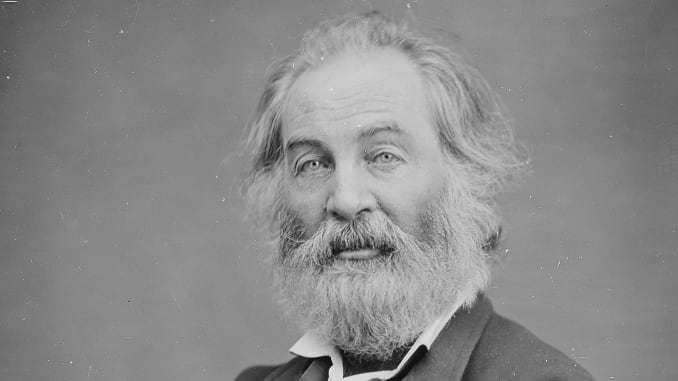
Written in the context of a seminar on American Literature and Culture, I found this poem by Walt Whitman to be exceptionally intriguing for a deep structural analysis. Throughout my paper I intended to explore the concept of the eidólon without getting lost in its wide philosophical range too much. Instead, I intended to keep the magic of it alive while still anchoring it in the concrete, exciting times of late 19th century U.S. culture.
Thy very songs not in thy songs,
No special strains to sing, none for itself,
But from the whole resulting, rising at last and floating,
A round full-orb’d eidólon.
Eidolons, Eidolons, Eidolons
At the heart of “Eidólons” is Whitman’s belief in the power of poetry to represent and shape democracy. The term eidólon, derived from Greek and referring to a spirit, double, or immaterial image in the Platonic sense, becomes for Whitman a metaphor for poetic vision itself (Kennedy 181).
Each eidólon is a vessel through which he captures the immensity of American life and its ideals. As scholar Krystyna Mazur points out, in “Eidólons,” Whitman shifts from an attempt to “name and
encompass everything” in his work toward a more focused ambition: capturing the entirety of experience within the eidólon itself (48). Through this figure, Whitman explores the dualities at the core of American identity: idealism and disillusionment, unity and fragmentation, permanence and change. His goal is not simply to reflect historical crises, but to offer poetry as an active participant in democracy, one that portrays the political and social realities of America in his time. This paper thus
argues, through detailed close reading and textual analysis, that Whitman moves beyond the static Platonic ideals and deliberately transforms the classical and philosophical concept of eidólons to create dynamic poetic symbols that mirror the concrete tensions and aspirations of post-Civil War
America. Through repetition, cyclical imagery, and temporal ambiguity, Whitman’s “Eidólons” uniquely engages with historical reality, and reflects both disillusionment and persistent democratic hope.
[…]
Whitman’s engagement in postwar politics and his corresponding negotiation between dualities is central in “Eidólons.” In order to understand the poem’s ambitions, it is first necessary to grasp its formal structure. Over 21 stanzas that are typically organized into quatrains, Whitman combines free verse with regular stanza forms and, through the work of diction, syntax, and symbolism, creates a fluid movement to it that helps stress “Eidólons’” thematic contrasts. Specifically, Whitman engages various forms of repetition to reflect the poem’s themes of continuity, duality, and transformation. On the one hand, the lines follow traditional patterns: punctuation is mostly uniform, each stanza’s first three lines end with a comma, and the final refrain ends with a period. On the other hand, the lines do not strictly follow formal rules, which makes them sound more natural. John E. Schwiebert aptly explains that Whitman often approximates traditional accentual-syllabic patterns but does not fully conform to them. Rather than disrupting the poem, this partial conformity strengthens its internal coherence (116–17). For instance, stanza 15 demonstrates a relatively steady rhythm (stressed syllables marked in bold):
Not this the world,
Nor these the universes, they the universes,
Purport and end, ever the permanent life of life,
Eidólons, eidólons. (lines 59–62)
In other stanzas, such as 3 and 4, this rhythmic pattern becomes more complex. Here, Whitman repeatedly opens lines with the phrase “Ever the,” two words that resist natural emphasis or strong stress (10–16). Because “Ever the” is inherently unstressed, it creates a subtle stumbling effect—almost as if the reader trips slightly before landing on words like “growth” or “summit” (11–12). A similar effect emerges from the poem’s visual and rhythmic structure. Harrison describes the poem’s stanzas as building toward a climax and receding again, which creates a wave-like rhythm
[…]
Closely related to repetition, and serving as its structural counterpart, is the cyclical organization of the poem. Whitman employs a carefully constructed circular form to reinforce themes of renewal, unity, and the interplay between individual identity and collective existence. The entire
poem is, in fact, built as a circle. At the beginning, two stanzas serve as an entry. First, we are introduced to a graspable identity: “I met a seer,” who moves through tangible scenes such as “the hues and objects of the world,” and the “fields of art and learning, pleasure, sense,” ultimately to “glean Eidólons” (1–4). In the second stanza, this seer instructs the speaker: “Put in thy chants,” declaring that this chant should be the chant of Eidólons—serving as “light for all and entrance-song of all” (8). From the outset, Whitman establishes a hymn-like structure designed to guide those who encounter it.
Entire essay provided upon request.


Leave a comment